




Access to precision laser technology remains a bottleneck for industries ranging from quantum computing to space communications. Specialised semiconductor lasers capable of producing exact wavelengths at high power have historically come from small-volume suppliers, creating constraints for organisations seeking reliable, scalable components.
A Finnish photonics manufacturer is now positioning itself to address that gap. The company’s expansion plans aim to shift production from boutique volumes to industrial scale, potentially opening new sourcing options for technology integrators globally.
Vexlum closes A$17M funding round
Vexlum, a Finnish manufacturer of advanced semiconductor lasers, has raised $17 million to expand its chip manufacturing and laser technology operations. The round comprised $10 million in equity led by Kvanted, with participation from Finnish state-owned Tesi and the EIC Fund, according to Robotics and Automation News.
The financing package also included a $4 million grant from the EIC Accelerator program and a $2.7 million loan from Nordea. The company said it will use the funds to expand manufacturing capacity into a new facility in Tampere.
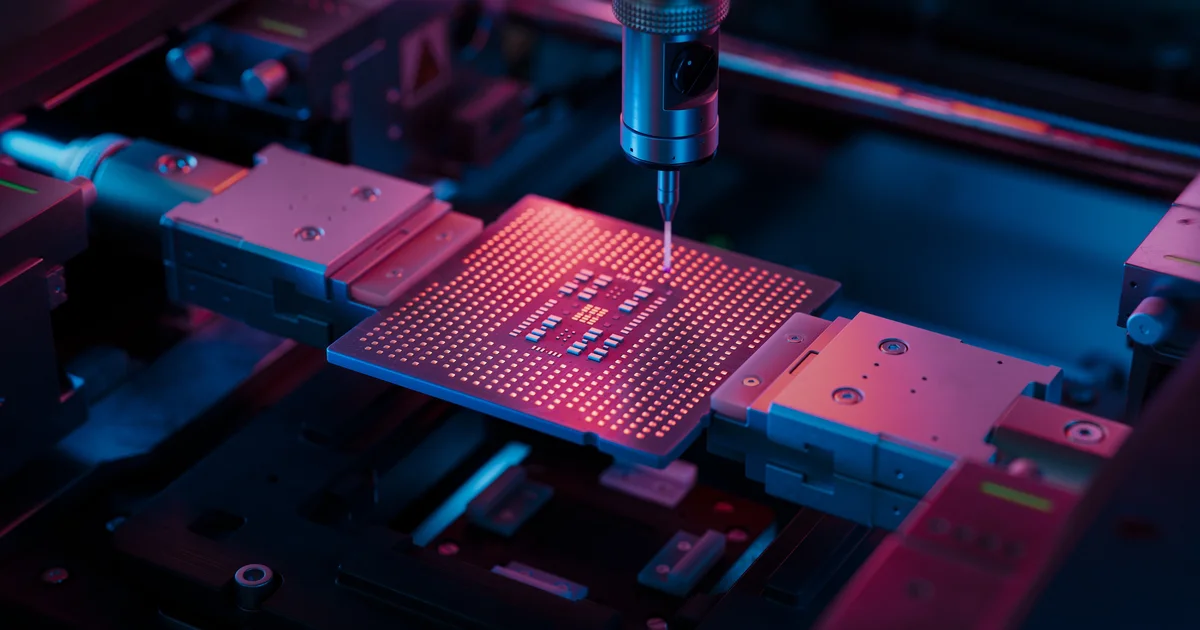
Vexlum develops Vertical-External-Cavity Surface-Emitting Laser (VECSEL) devices built on III-V semiconductor wafers such as gallium arsenide, indium phosphide and gallium antimonide. The manufacturing process uses molecular beam epitaxy to grow wafers atom by atom before cleanroom chip processing and integration into final laser systems.
Quantum and space applications drive demand
The company said it is already a major supplier for trapped-ion quantum computers and listed additional target markets including atomic clocks, semiconductor metrology and satellite optical communications. These sectors require laser sources capable of producing precise wavelengths with high stability and power output.
Atomic clocks and quantum computers depend on lasers to manipulate individual atoms or ions with extreme accuracy. Satellite optical communications use lasers to transmit data between spacecraft and ground stations, offering higher bandwidth than traditional radio frequency links.
The funding was framed as a milestone for the Nordic deep-tech ecosystem, according to the company. Vexlum said it has growth plans toward materially larger revenue targets by 2030.
Vertical integration in laser manufacturing
Vexlum controls the full production chain from wafer growth through chip fabrication to final laser system assembly, the company said. This vertical integration gives the manufacturer greater control over quality, speed and the ability to meet customer-specific wavelength requirements.
For organisations integrating precision lasers into products and systems, verticalised manufacturing could reduce supplier risk and shorten lead times compared to sourcing from fragmented supply chains. The approach also improves traceability, which matters in sectors where reliability and precision are critical.
The transition from boutique to industrial-scale production represents a shift in the photonics supply landscape. If successful, it could provide procurement teams with access to more consistent, scalable laser sources at specific wavelengths.
Photonics supply chains and Australia
Australia’s growing quantum computing and space technology sectors could benefit from expanded global supply options for precision laser components. Organisations such as quantum computing developers and satellite operators may find improved access to specialised photonics hardware as manufacturers like Vexlum scale production.
The country’s space industry, supported by the Australian Space Agency’s goal to triple the sector’s size by 2030, includes satellite communications projects that rely on advanced optical technologies. Domestic quantum computing research at institutions including the University of New South Wales and the University of Sydney also requires precision laser sources.
Vexlum’s expansion does not directly involve Australian operations, but the scaling of industrial photonics capacity in Europe could create new procurement pathways for Australian technology integrators evaluating international suppliers.
What Vexlum’s expansion signals for photonics
Until now, organisations building quantum computers or satellite communications systems have faced a bottleneck: precision lasers have largely come from small-batch suppliers unable to scale with demand. Vexlum is betting that vertical integration—controlling everything from atomic-layer wafer growth to final assembly—can break that constraint.
The real test comes when the Tampere facility goes live. If Vexlum can hit production volumes without sacrificing the nanometre-level precision these industries require, it could reshape how quantum and space technology projects source critical components. The company’s 2030 revenue targets will reveal whether industrial-scale photonics is viable or still a niche game.
For Australian quantum computing and space ventures, the implications are worth watching. As local projects scale up and demand reliable component supply chains, having more global manufacturers in the mix means less reliance on a handful of specialist shops—and potentially faster paths from prototype to production.