Llevo más de tres años probando herramientas de IA y viéndolas pasar de chatbots curiosos a motores de productividad. Como parte de Aivy, una consultora de automatización con IA, paso casi todo el día ayudando a empresas a decidir qué herramientas rinden de verdad. La pregunta de Claude contra ChatGPT sale en casi todas las conversaciones, y la respuesta honesta rara vez es una victoria limpia para ninguno.
En octubre la pelea cambió: desde el día 7, el chat de pago de ChatGPT responde con GPT 6 Sol, y en Claude el día a día lo cubre Sonnet 5.5, a la mitad por token que Opus 5.5. Si una tarea pide subir Sonnet por encima del esfuerzo alto, sale más a cuenta cambiar de modelo que de dial, como contamos en Opus 5 frente a Fable 5.
En esta guía comparto lo que he aprendido usando las dos herramientas a diario con clientes de sectores distintos: dónde gana cada una, dónde sufre y qué elegir en escenarios reales de empresa, sin humo de marketing. Antes de elegir conviene saber qué herramientas de IA usa de verdad tu equipo, que casi nunca coincide con lo aprobado, porque la herramienta buena es la que tu gente acaba usando.
Claude vs ChatGPT: las diferencias clave de un vistazo
Antes del detalle, así está cada plataforma en octubre de 2026. En Claude el buque insignia es Claude Opus 5.5, con Fable 5.1 por encima como el modelo más capaz a la venta, y la gama actual la completan Sonnet 5.5 y Haiku 5.5. Opus 5, Fable 5 y Opus 4.8 ya figuran como heredados en la documentación de Anthropic, aunque siguen disponibles.
En ChatGPT, el chat funciona desde el 7 de octubre con GPT 6 Sol en Plus, Pro, Business y Enterprise, con un despliegue gradual, y GPT 5.6 Sol sigue en el selector para quien lo elija. Por encima está GPT 6 Astra, el modelo más capaz de OpenAI desde el 3 de septiembre, que en el chat mueve el modo Pro de Pro 100, Pro 200, Business y Enterprise.
| Característica | Claude (Anthropic) | ChatGPT (OpenAI) |
|---|---|---|
| Modelo estrella | Claude Opus 5.5 (Fable 5.1 por encima) | GPT 6 Sol en ChatGPT (GPT 6 Astra por encima, en Pro) |
| Ventana de contexto | 1M de tokens por defecto | 1,05M en GPT 6 Sol |
| Generación de imágenes | No | Sí (imágenes; Sora cerró en 2026) |
| Agente de programación | Claude Code | Codex |
| Asistentes a medida | Projects | GPTs personalizados + GPT Store |
| Plan de pago de entrada | Claude Pro, 22 €/mes con IVA (18 € sin IVA) | ChatGPT Plus, 22,99 €/mes (Go, 7,99 €) |
| Mejor para | Programación, documentos largos, escritura con matices · Fable 5.1 es el nivel más capaz de Claude; Fable 5 (disponible desde el 9 de junio de 2026) pasa a heredado | Visuales, bots a medida, integraciones amplias |
Y el 29 de septiembre llegó GPT 6.1 Sol, una versión mejorada de Sol que, según OpenAI, casi iguala a Astra en programación con agentes, uso del ordenador y trabajo profesional por la quinta parte de su tarifa. De momento solo está en ChatGPT Work y Codex, no en el chat. Las secciones siguientes bajan la tabla al trabajo concreto.
Claude vs ChatGPT para programar
Aquí sigo viendo la brecha más clara del trabajo diario. Claude produce código más limpio, que necesita menos depuración, y SWE bench Pro, que mide incidencias reales de repositorio, lo respalda: Claude Opus 5.5 marca 89,9% según su system card, Opus 5 un 79,2% y GPT 5.6 Sol un 64,6%. Si buscas un agente que viva en tu editor o tu terminal, lo desmenuzamos en Cursor vs Claude Code.
SWE-bench Pro: programación sobre repositorios reales (más alto es mejor)
Eje de 0 a 100%. Fuente: leaderboard público de SWE-bench Pro, datos de agosto de 2026. La de Claude Opus 5.5 procede de su system card (tabla 8.1.A, septiembre de 2026), a esfuerzo máximo.
La ventaja no es un caso aislado. En Humanity’s Last Exam, otra prueba dura de razonamiento, Claude también salía por delante en el panel de agosto de 2026: Opus 5 marcaba 64,7%, Opus 4.8 un 57,9% y GPT 5.5 un 57,2%, y los modelos nuevos aún no figuran. Para programar, esa capacidad se aprovecha sobre todo fuera del chat, en Claude Code, el agente que trabaja en tus carpetas.
Humanity’s Last Exam (más alto es mejor)
Eje de 0 a 100%. Fuente: leaderboard público de Humanity’s Last Exam en BenchLM, consultado el 11 de agosto de 2026. GPT 5.6 Sol todavía no figura en ese panel, por eso la comparación de OpenAI se queda en GPT 5.5. El panel avisa de que las pruebas con herramientas y a libro cerrado no responden a lo mismo.
En el trabajo de verdad, la pelea está en los agentes de programación, y cada casa tiene el suyo:
- Claude Code: trabaja en tu terminal, lee el proyecto entero, edita entre archivos y ejecuta tests por su cuenta. Desde su versión 2.1.280 arranca en Claude Opus 5.5 en Pro y Max, y para calidad de código pura en problemas difíciles y multiarchivo sigue teniendo la ventaja en mis pruebas.
- Codex: el agente de OpenAI, cuyo modelo recomendado hoy es GPT 6.1 Sol, con GPT 6 Astra en los planes de pago. Los dos son fuertes, y cubrimos esa pelea al detalle en nuestra comparativa Claude Code vs Codex.
- La integración: ChatGPT encaja más fácil en los flujos existentes, y muchas herramientas estrenaron antes las integraciones de Codex y GPT. Si tu equipo ya vive en OpenAI, cambiar tiene un coste real; y si dudas entre asistentes dentro del editor, compara Cursor frente a GitHub Copilot antes de decidir.
Claude vs ChatGPT para escribir y crear
La brecha en escritura se ha estrechado, pero Claude sigue produciendo una prosa más natural según mi experiencia. Cuando redacto propuestas para clientes o textos de marketing, lo que sale de Claude necesita menos retoques para sonar humano. Evita los patrones de fórmula que delatan al texto de IA y mantiene la coherencia de voz en documentos largos, recordando el tono y la terminología de secciones anteriores.
ChatGPT contraataca con versatilidad. ¿Necesitas un memorando formal, un post desenfadado y una especificación técnica en la misma tarde? Cambia de registro con suavidad y maneja bien el contenido multilingüe, algo que importa a las empresas que atienden a comunidades diversas o venden fuera.
Para trabajo creativo, como idear campañas, los dos rinden bien: ChatGPT tira a lo convencional y Claude a veces sorprende con ángulos más afilados. A menudo paso el mismo briefing por los dos y me quedo con lo mejor de cada uno. Los dos escriben a nivel profesional, y la diferencia está en el tiempo de edición. Para campañas completas conviene sumarles el resto de herramientas de IA para marketing.
La ventana de contexto de Claude y ChatGPT en 2026
La ventana de contexto es cuánto puede retener una IA en memoria activa a la vez. Era la mayor ventaja estructural de Claude y en 2026 ha dejado de serlo: toda su gama actual, de Haiku 5.5 a Fable 5.1, trae 1M de tokens, igual que Opus 5 y Sonnet 5, y GPT 6 Sol, GPT 6.1 Sol, GPT 6 Luna y GPT 5.6 Sol declaran 1.050.000 en la API.
GPT 6 Astra se mueve en la misma escala: 1.050.000 tokens de contexto, 922.000 de entrada máxima y 128.000 de salida, el mismo techo que Opus 5 y Fable 5.1, con corte de conocimiento el 30 de abril de 2026. Si el contexto es tu criterio número uno, mira también nuestra comparativa Claude vs Gemini: Gemini 4 Argon y Gemini 3.8 Flash juegan en el mismo millón de tokens.
Ventana de contexto por defecto (tokens)
Barras a escala de la mayor. Fuentes: documentación de la API de Claude; planes de ChatGPT; fichas de GPT 6 Sol, GPT 6.1 Sol y GPT 6 Luna de OpenAI, septiembre de 2026.
Cifras de API: 1M de tokens en Claude y 1.050.000 en GPT 5.6 Sol, GPT 6 Sol, GPT 6.1 Sol y GPT 6 Luna. Dentro de la app de ChatGPT el límite útil depende del plan.
En la práctica, 1M de tokens equivale a unas 555.000 palabras con el tokenizador actual de Claude: caben contratos enteros o lotes de pólizas, y puedes hacer preguntas que los crucen. Para el trabajo legal y de cumplimiento, eso hace de Claude el punto de partida más cómodo para analizar legislación larga, aunque los modelos de OpenAI alcanzan la misma escala sin pagar un nivel superior.
Agentes de IA: Claude Code contra Codex y ChatGPT Work
Los agentes son donde más empujan las dos compañías, y sus filosofías difieren. Claude Code se centra en el software: apúntalo a una base de código y navega archivos, escribe funcionalidades, arregla bugs y ejecuta tests con poca supervisión. ChatGPT tiene Codex para ese mismo trabajo y ChatGPT Work para tareas largas de varios pasos; Operator y el modo agente ya no existen, y OpenAI remite a Work.
Para una empresa, Work y Dots, el agente siempre encendido de OpenAI, apuntan a automatizar pedidos a proveedores, reservas o recogida de datos, aunque Dots solo llega a España con el asiento Premium de Business. Los agentes de propósito general todavía fallan más que un flujo especializado, como la automatización de cuentas a pagar y facturas de proveedor.
Los GPTs personalizados siguen siendo la ventaja de ChatGPT para la automatización no relacionada con código. Puedes construir asistentes entrenados con tus procedimientos y datos, y publicarlos en la GPT Store. Claude tiene Projects para una organización parecida, pero nada que iguale ese mercado. Si quieres desplegar un chatbot de IA a medida para atención al cliente o consultas de RRHH con rapidez, ChatGPT es el camino más corto.
Imagen: donde ChatGPT gana sin discusión
Esta es la ventaja más clara de ChatGPT: genera imágenes de forma nativa dentro de la misma conversación, y Claude no genera ni imágenes ni vídeo, por diseño. El vídeo ya no entra en la pelea: OpenAI cerró la app y la web de Sora el 26 de abril de 2026 y su API el 24 de septiembre, y los planes de ChatGPT ya no anuncian vídeo.
Para los equipos de marketing y contenido esto importa. Puedes pedirle a ChatGPT que escriba un post de LinkedIn y produzca la imagen a juego sin cambiar de herramienta. Y desde el 7 de octubre, GPT 6 en el chat también responde con gráficos, botones, formularios y pequeñas herramientas dentro de la propia respuesta, lo que OpenAI llama Intelligent UI.
Claude toma el camino contrario a propósito y se centra en texto, código y análisis. Si lo visual es central en tu trabajo, ChatGPT gana por defecto; si trabajas sobre todo con texto, esa carencia no te cuesta nada y su trabajo de texto puede rendirte más. Para comparar generadores entre sí, nuestra comparativa ChatGPT vs Gemini enfrenta a los dos que más aprietan en imagen.
API de Claude y ChatGPT: precios para desarrolladores
Para los equipos que meten la IA dentro de sus productos, el precio de la API importa más que el plan de consumo, y los dos han convergido. Esta es la tarifa de lista por millón de tokens de entrada y de salida, al tipo del BCE del 22 de septiembre de 2026:
- Claude Opus 5.5: 3,49 € y 17,45 €, lo mismo que GPT 5.6 Sol a precio promocional, que OpenAI mantiene al menos hasta el 21 de noviembre de 2026. Es por donde la documentación de Anthropic recomienda empezar en la mayoría de cargas.
- Claude Opus 5: 4,36 € y 21,81 €, la misma tarifa que Claude Opus 4.8.
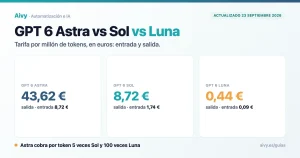
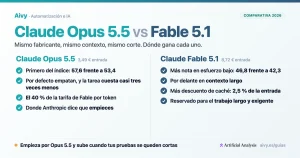
- Claude Fable 5.1: 8,72 € y 43,62 €, lo que costaba Fable 5. Solo baja la lectura de caché, un 75% más barata, hasta 0,22 € por millón: el ahorro del 25% al 45% que anuncia Anthropic aparece si la carga reutiliza caché, y sin ella Fable 5.1 cuesta el doble que Opus 5.
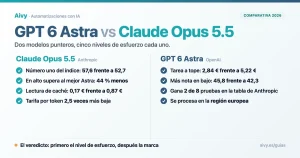
- GPT 6 Astra: 8,72 € y 43,62 €, la misma tarifa que Fable 5.1. Que cobren igual no significa que cuesten igual: eso es qué pasa cuando compiten los dos topes de gama.
- GPT 6 Sol y GPT 6.1 Sol: 1,74 € y 8,72 €, para código y agentes, igual que Claude Sonnet 5.5.
- GPT 6 Luna: 0,09 € y 0,44 €, para tareas acotadas de gran volumen, la misma tarifa que Claude Haiku 5.5 con prompts de hasta 100.000 tokens.
Ojo con el tramo: una petición de Astra que pase de 272.000 tokens de entrada se factura entera al doble en entrada y a 1,5 veces en salida. Batch y Flex bajan al 50% y Fast sube al doble. Aun así, a esfuerzo alto, Astra sale algo más barato por tarea que Gemini 4 Argon con su tarifa de lanzamiento, vigente hasta el 30 de noviembre.
Precio de API, salida por millón de tokens
Barras a escala de la mayor. Precio de lista, tramo estándar. Tipo del BCE del 22 de septiembre de 2026. Fuentes: claude.com/pricing, con Claude Sonnet 5.5 leído el 28 de septiembre; openai.com/api/pricing, con GPT 6.1 Sol leído el 29 de septiembre.
OpenAI sigue teniendo el ecosistema de desarrolladores más maduro: años de documentación, SDKs en todos los lenguajes principales y el mayor abanico de herramientas externas. Anthropic ha cerrado buena parte de esa brecha, pero ChatGPT sigue siendo el camino más suave si dependes de integraciones preconstruidas en plataformas de automatización como las que repasamos en nuestra guía de alternativas a Zapier (Make y n8n).
Un apunte para los equipos españoles
Ninguna de las dos ofrece residencia de datos local por defecto, así que las llamadas a la API viajan fuera. Si manejas información sensible bajo el RGPD, contrasta eso con tus obligaciones antes de construir. Es de las primeras dudas que nos trasladan las empresas que buscan una agencia de inteligencia artificial en Barcelona.
Eficiencia de tokens: por qué Claude te sale más caro por tarea
El precio por token es solo la mitad de la historia: lo que mueve tu factura es cuántos tokens quema un modelo para terminar el mismo trabajo, y Artificial Analysis mide esa verbosidad. En agosto, para completar el Intelligence Index v4.1.1, Claude Opus 4.8 generó 120 millones de tokens de salida y Opus 5, 100 millones, frente a una mediana de 66 millones; GPT 5.6 Sol se quedó en 70.
Coste por tarea en el índice de Artificial Analysis (euros)
Barras a escala de la mayor. Cada modelo a su esfuerzo máximo. Fuente: Artificial Analysis (artificialanalysis.ai), Intelligence Index v4.3, leído el 23 de septiembre de 2026 (Claude Sonnet 5.5, el 18 de octubre, y GPT 6.1 Sol, el 29 de septiembre), al tipo del BCE del 22 de septiembre.
Basado en datos de Artificial Analysis, leídos el 23 y el 29 de septiembre y el 18 de octubre de 2026. Artificial Analysis no avala este análisis ni es responsable de él.

Y la tarifa no lo compensa: la salida de Opus 5 cuesta 21,81 € por millón frente a 17,45 € de GPT 5.6 Sol, y Opus 5.5, que iguala esa tarifa, sigue muy por encima en coste por tarea. En el Intelligence Index v4.3 la nota está cerca, 50,8 para Opus 5 y 47,0 para GPT 5.6 Sol. La tabla pone rendimiento, precio y verbosidad lado a lado:
| Métrica | Claude Opus 5.5 | Claude Sonnet 5.5 | Claude Opus 5 | GPT 6.1 Sol | GPT 6 Luna | GPT 5.6 Sol |
|---|---|---|---|---|---|---|
| Intelligence Index v4.3, esfuerzo máximo (más alto es mejor) | 57,6 (el primero de la tabla) | 56,0 | 50,8 | 51,8 | 37,3 | 47,0 (GPT 6 Astra sube a 52,7) |
| Precio API, entrada (por 1M) | 3,49 € | 1,74 € | 4,36 € | 1,74 € | 0,09 € | 3,49 € |
| Precio API, salida (por 1M) | 17,45 € | 8,72 € | 21,81 € | 8,72 € | 0,44 € | 17,45 € (promocional) |
| Tokens de salida para ejecutar la evaluación (v4.1.1, agosto de 2026) | Sin dato comparable | Sin dato comparable | 100M (mediana del sector: 66M) | Sin dato comparable | Sin dato comparable | 70M (apenas por encima de la mediana) |
| Coste por tarea en el índice (v4.3, esfuerzo máximo) | ~5,22 € | ~4,76 € (18 de octubre) | ~5,11 € | ~0,63 € | ~0,06 € | ~1,73 € |
Basado en datos de Artificial Analysis, leídos el 23, el 28 y el 29 de septiembre de 2026. Artificial Analysis no avala este análisis ni es responsable de él.
- Claude Opus 5.5: El esfuerzo también mueve su cuenta. Con esfuerzo alto baja a 1,59 € por tarea y aún marca 53,6, por encima de cualquier modelo de OpenAI de la tabla; GPT 6 Sol a su máximo se queda en 47,5 por 0,92 €. Lo que compras con Claude es nota, no ahorro.
- A la tarifa de Sol: Claude Sonnet 5.5, que llegó el 28 de septiembre, cobra por token lo mismo que GPT 6 Sol. A esfuerzo máximo marca 56,0, 8,5 puntos más que Sol, pero su tarea cuesta 4,76 € frente a 0,92 €; a esfuerzo alto, 46,7 por 0,77 €. Está en todos los planes de Claude.ai, también el gratuito.
- GPT 6.1 Sol: del 29 de septiembre, estrecha la distancia sin tocar la tarifa: 51,83 a máximo por 0,63 € la tarea, y 51,04 por 0,34 € a esfuerzo muy alto, casi la nota de Sonnet 5.5 en ese esfuerzo, 51,85, que cuesta 1,75 €. Cómo se comparan los dos selectores lo tienes en el esfuerzo en Claude y en ChatGPT.
- Gemini 4 Argon: a igual esfuerzo, ni Gemini 4 Argon alcanza a Opus 5.5, y encima gasta más por tarea.
- La clasificación: en la v4.3 manda Claude Opus 5.5 con 57,6, seguido de Sonnet 5.5 (56,0), Fable 5.1 (53,4), GPT 6 Astra (52,7), GPT 6.1 Sol (51,8) y Opus 5 (50,8). Si ejecutas cargas de API de gran volumen, GPT 5.6 gasta menos tokens y no cobra más por cada uno.
Para un usuario de suscripción nada de esto se nota en la factura: la cuota de unos 22 € al mes no cambia por gastar más o menos tokens. Si lo que te interesa es llevar la IA a las cuentas, lo vemos en inteligencia artificial para la contabilidad con Holded y Sage.
Planes de Claude y ChatGPT: ¿cuál es más barato?
El precio de consumo ya no es un empate simple: los dos manejan una escalera completa. Los planes de ChatGPT y Claude Pro van con el IVA que pagas en España; Claude publica sus euros sin IVA en su página de precios:
- ChatGPT: gratis, Go por 7,99 €, Plus por 22,99 € y tres planes Pro: Pro 100 por 102,99 €, Pro 200 por 229 € y, desde el 29 de septiembre, Pro 500 por 509,99 €. Lo que añade cada uno está en nuestra guía de planes de ChatGPT.
- Claude: gratis, Pro por 22 € con IVA (18 € sin IVA, o 15 € al mes con pago anual) y Max desde 90 € sin IVA, con 5 o 20 veces el uso de Pro, para usuarios intensivos.
- Qué modelo te toca: de Plus para arriba, el chat de ChatGPT funciona con GPT 6 Sol desde el 7 de octubre, y GPT 6 Pro, con Astra, está en Pro 100, Pro 200, Business y Enterprise. En Claude, Sonnet 5.5 está en todos los planes, también el gratuito, y Opus, desde Pro.
- Pro 500 y Dots: Pro 500 trae 25 veces el uso de Plus, según OpenAI, y es el único con Ultrafast; Pro 200 vuelve a admitir altas, con menos uso incluido que antes. Dots, el agente siempre encendido de OpenAI, va en Pro en otros países, pero no en España: qué agente puedes contratar desde aquí lo resolvemos en nuestra guía de los mejores agentes de IA.
Para la mayoría de la gente, el plan de unos 22 € de cualquiera de las dos es el punto de partida correcto, y el valor está francamente igualado. Go encaja con usuarios ligeros y los Pro, con flujos intensivos de gran volumen. Si entre tus opciones también valoras una IA centrada en búsqueda, te interesa la comparativa Perplexity vs ChatGPT.
Escalera de planes de pago (al mes)
Barras a escala de la mayor. Planes de ChatGPT y Claude Pro, precio para España con IVA, leído el 30 de septiembre de 2026; Claude Max 5x, desde 90 € sin IVA en su página de precios (19 de octubre de 2026); Max 20x, que solo se publica en dólares, convertido sin IVA al tipo del BCE del 22 de septiembre. Fuentes: chatgpt.com/pricing; claude.com/pricing.
La escalera más simple de Claude es más fácil de entender si solo quieres el mejor modelo sin bucear entre seis opciones. Y si lo que te frena es justificar el gasto, nuestra calculadora de ROI de IA te da una estimación del retorno en un par de minutos.
Seguridad y ética de la IA: Anthropic contra OpenAI
Anthropic se fundó para construir una IA más segura, y ese origen da forma a Claude: su enfoque de IA constitucional lo entrena para contrastar sus propias respuestas con un conjunto de principios. En la práctica, Claude tira a prudente: rechaza ciertas peticiones con más facilidad, a veces de forma frustrante, pero evita salidas dañinas con más consistencia.
Para las empresas preocupadas por el mal uso de la IA en la plantilla, esas barandillas son una ventaja, y encajan con lo que exige el cumplimiento del RGPD y el AI Act. OpenAI sigue una línea más permisiva: confía en el criterio del usuario e integra la seguridad en las funciones de más riesgo, así que ChatGPT atiende más peticiones y algunas salidas piden un filtro humano.
Para las organizaciones que navegan la gobernanza de la IA, este es un factor de elección real. En sanidad, servicios jurídicos o administración pública, los valores por defecto conservadores de Claude pueden reducir riesgo; en salud lo aterrizamos en nuestra guía de IA para clínicas y su normativa. Si necesitas la máxima flexibilidad y confías en tu equipo, ChatGPT quita fricción.
Claude o ChatGPT para tu empresa: ¿cuál es mejor?
Después de ayudar a decenas de empresas a desplegar IA, he aprendido que mejor depende por completo del trabajo. Elige Claude si tu equipo trabaja sobre todo con texto: despachos que revisan contratos, consultoras que redactan informes, agencias que producen contenido escrito y equipos de desarrollo que valoran la calidad del código. La ventana de 1M maneja documentos complejos sin apaños incómodos.
¿Comparando los planes de empresa de pago? Mira ChatGPT Business vs Claude Team vs Copilot para el desglose de precios por nivel de equipo y residencia de datos.
Elige ChatGPT si necesitas amplitud antes que profundidad. Marketing aprovecha la imagen integrada, ventas los GPTs personalizados entrenados con el catálogo y operaciones, las integraciones preconstruidas: si tu trabajo cruza muchos tipos de contenido, el ecosistema de ChatGPT se acumula a su favor. Para atención al cliente conviene mirar además qué hace falta en el mejor chatbot de IA para atención al cliente.
Para autónomos y equipos pequeños, suelo sugerir empezar con un plan de unos 22 €, aprender tus necesidades reales y decidir después si la otra herramienta se gana su sitio. Muchos de nuestros clientes usan las dos y dirigen cada tarea al lado más fuerte. A unos 45 € al mes en total, a menudo se paga solo en la primera semana de tiempo ahorrado.
¿Y los datos de tus clientes?
Elijas Claude o ChatGPT, lo que tu equipo pega suele ser un correo de un cliente, una cláusula de un contrato o una hoja con su DNI o su IBAN, y todo eso viaja a los servidores del fabricante. Seleccionas el texto, pulsas una tecla y Nonimo cambia por marcadores los identificadores que reconoce antes de que el texto llegue a ChatGPT, Claude o Copilot, y los devuelve a su sitio en la respuesta.
Funciona en tu propio ordenador, Mac o Windows: de tu texto no sale ni una palabra hacia Nonimo, solo un contador de uso diario. Mira cómo se tapan los datos de un expediente antes de pegarlo.
Claude o ChatGPT: la conclusión para equipos españoles
Inclínate por Claude si trabajas con texto, código o documentos largos, analizas material complejo en una sola sesión y valoras una escritura cuidadosa con barandillas conservadoras. Inclínate por ChatGPT si necesitas generar imágenes, dependes de integraciones amplias o quieres asistentes a medida. Y si tu empresa ya vive en Microsoft, mira antes la comparativa de Copilot y ChatGPT para empresas.
Para muchas empresas la respuesta honesta es ambas: Claude por defecto para texto y código, y ChatGPT para lo visual. Las dos mejoran tan rápido que esta comparativa volverá a moverse en meses, y como cada vez más gente pregunta a Claude y a ChatGPT en vez de buscar en Google, salir citado en esas respuestas, con el posicionamiento en buscadores de IA, ya es una prioridad propia.
Si prefieres no resolverlo por tu cuenta, nuestro trabajo de consultoría y estrategia de IA mapea el stack de IA correcto para tu flujo y tus necesidades de cumplimiento. ¿Prefieres una recomendación para tu equipo en vez de un benchmark más? Reserva una sesión de descubrimiento gratuita y la bajamos a tu caso concreto, sin guion comercial.
Preguntas frecuentes sobre Claude y ChatGPT
¿Es Claude mejor que ChatGPT en 2026?
En los benchmarks de agosto de 2026 Claude va por delante para programar, documentos largos y escritura natural: Opus 5 marca 79,2% en SWE-bench Pro y Fable 5 sube a 80,0%, frente al 64,6% de GPT 5.6 Sol. En el Intelligence Index v4.3 de Artificial Analysis lidera ahora Claude Opus 5.5 (57,6), por delante de Fable 5.1 (53,4) y GPT 6 Astra (52,7). ChatGPT es mejor en generación de imagen y vídeo y tiene más integraciones. La mejor elección depende de tu tarea principal.
¿Cuál es la diferencia entre Claude y ChatGPT?
Claude, de Anthropic, se centra en texto, código y seguridad, con 1M de tokens de contexto en toda su gama actual. ChatGPT, de OpenAI, funciona en el chat de pago con GPT 6 Sol desde el 7 de octubre de 2026, genera imágenes y tiene un gran ecosistema de GPTs personalizados; su modelo más capaz es GPT 6 Astra. Los dos empiezan en unos 22 € al mes con IVA.
Claude Opus 5 contra GPT 5.6: ¿cuál es más listo?
Ninguno gana en todo. En el Intelligence Index v4.3 de Artificial Analysis, leído el 23 de septiembre de 2026, Claude Opus 5 marca 50,8 frente a 47,0 de GPT 5.6 Sol y puntúa más alto en programación, mientras GPT 5.6 es más fuerte en tareas multimodales y tiene funciones generales más amplias. Ese panel lo encabeza ahora Claude Opus 5.5 con 57,6, y GPT 6 Astra, con 52,7, queda por delante de Opus 5. El rendimiento real depende más de la tarea que de una sola puntuación.
¿Claude o ChatGPT para programar?
En los benchmarks de agosto de 2026 Claude va por delante para programar: Opus 5 supera a GPT 5.6 Sol en SWE-bench Pro (79,2% frente a 64,6%, y Fable 5 lleva a Claude al 80,0%), y su agente Claude Code trabaja sobre una base de código completa en la terminal. En el Intelligence Index v4.3, Claude Fable 5.1 marca 53,4 y GPT 6 Astra 52,7, por debajo de Claude Opus 5.5 (57,6). Codex, el de ChatGPT, también es fuerte, sobre todo si tus herramientas ya lo integran.
¿Quién tiene la ventana de contexto más grande, Claude o ChatGPT?
Hoy están a la par. Claude Opus 5 ofrece 1M de tokens de serie y GPT 5.6 Sol declara 1.050.000 en la API de OpenAI, con 128.000 de salida máxima. Para documentos largos en una sola sesión sirven los dos, y la elección se juega en precio y en calidad de respuesta.
¿Cuánto cuesta Claude comparado con ChatGPT?
Claude Pro cuesta 22 € al mes y ChatGPT Plus 22,99 €, IVA incluido, en su plan de pago principal. ChatGPT tiene además el plan Go, por 7,99 €, y tres planes Pro: 102,99 €, 229 € y 509,99 €. En la API, Claude Opus 5.5 cuesta 3,49 € de entrada y 17,45 € de salida por millón de tokens, lo mismo que GPT 5.6 Sol; Claude Opus 5 sigue en 4,36 € y 21,81 €, y GPT 6 Sol baja a 1,74 € y 8,72 €.
¿Puede Claude crear imágenes?
No. Claude no genera imágenes, por diseño. Para imágenes con IA usa ChatGPT, o herramientas independientes como Midjourney. Vídeo no genera ninguno de los dos: OpenAI cerró Sora, su generador de vídeo, en abril de 2026.
¿Debería usar Claude o ChatGPT en mi empresa?
Usa Claude para contratos, informes, investigación y programación, sobre todo donde la ventana de contexto grande y las barandillas conservadoras ayudan con el cumplimiento. Usa ChatGPT para contenido visual, asistentes a medida e integración intensiva. Muchos equipos usan los dos y dirigen cada tarea a la herramienta más fuerte.
¿Cuál es más seguro para sectores regulados, Claude o ChatGPT?
Claude tiende a ser más conservador y rechaza peticiones arriesgadas con más facilidad, lo que puede encajar en sanidad, legal y administración pública. Ninguno ofrece residencia de datos en España por defecto, así que contrasta el tratamiento de datos fuera del EEE con tus obligaciones de RGPD antes de desplegar cualquiera de los dos.
¿Necesito Claude y ChatGPT a la vez?
No siempre, pero muchas empresas sacan partido de los dos. Por unos 45 € al mes en total tienes las fortalezas de texto y código de Claude más los visuales y las integraciones de ChatGPT, y diriges cada tarea a la herramienta más fuerte. Empieza con un plan de unos 22 € y añade el segundo solo si aparece un hueco real.
Última actualización: 19 de octubre de 2026, con Claude Opus 5.5, Claude Fable 5.1, Claude Opus 5, GPT 6 Sol, GPT 6.1 Sol, GPT 6 Luna y GPT 5.6 Sol. Cifras verificadas contra Anthropic, OpenAI y Artificial Analysis. Revisamos esta comparativa cada trimestre.
- Anthropic, lanzamiento de Claude Opus 4.8: fecha de lanzamiento y precios de Opus 4.8. Las ventanas de contexto y los resultados de benchmark se citan desde la documentación de modelos de Anthropic y desde los leaderboards públicos.
- Precios de Claude: Claude Pro 22 €/mes en España con IVA; API de Claude Opus 5.5, 3,49 € de entrada y 17,45 € de salida por millón de tokens; de Opus 5, 4,36 € y 21,81 €; de Fable 5.1 y Fable 5, 8,72 € y 43,62 €.
- Planes de ChatGPT: niveles Free, Go (7,99 €), Plus (22,99 €) y Pro 100, Pro 200 y Pro 500 (102,99 €, 229 € y 509,99 €), precios para España con IVA leídos el 30 de septiembre de 2026, y disponibilidad de GPT 5.6.
- Precios de la API de OpenAI: GPT 5.6 Sol a 3,49 € de entrada y 17,45 € de salida por millón de tokens, precio promocional hasta al menos el 21 de noviembre de 2026; GPT 6 Sol a 1,74 € y 8,72 €; GPT 6 Luna a 0,09 € y 0,44 €; GPT 6 Astra a 8,72 € y 43,62 €.
- Artificial Analysis, Claude Opus 5: verbosidad de salida medida en la v4.1.1, ya retirada.
- Fuente: Artificial Analysis (artificialanalysis.ai): Intelligence Index v4.3 leído el 23 de septiembre de 2026, a esfuerzo máximo: 57,6 (Claude Opus 5.5), 53,4 (Claude Fable 5.1), 52,7 (GPT 6 Astra), 50,8 (Claude Opus 5), 47,5 (GPT 6 Sol), 47,0 (GPT 5.6 Sol) y 37,3 (GPT 6 Luna); coste por tarea de 5,22 €, 5,11 €, 0,92 €, 1,73 € y 0,06 € para Opus 5.5, Opus 5, GPT 6 Sol, GPT 5.6 Sol y GPT 6 Luna. Claude Sonnet 5.5, leído el 28 de septiembre: 56,0 y 6,63 € por tarea a esfuerzo máximo. GPT 6.1 Sol, leído el 29: 51,83 y 0,63 € a máximo, 51,04 y 0,34 € a muy alto. Basado en datos de Artificial Analysis, leídos el 23, el 28 y el 29 de septiembre de 2026. Artificial Analysis no avala este análisis ni es responsable de él.
- Anthropic, system card de Claude Opus 5.5: SWE bench Pro 89,9% (tabla 8.1.A, esfuerzo máximo, media de cinco intentos).
- OpenAI, ficha de GPT 6 Sol, de GPT 6 Luna y de GPT 6 Astra: 1.050.000 tokens de contexto y 128.000 de salida máxima en los tres; corte de conocimiento de Astra, 30 de abril de 2026. Leídas el 22 de septiembre de 2026.
- OpenAI, anuncio de GPT 6.1 Sol: versión mejorada de GPT 6 Sol, con la tarifa de 2 y 10 USD por millón de tokens, disponible en ChatGPT Work y Codex para los planes de pago y aún no en el chat. 29 de septiembre de 2026.
- Artificial Analysis, GPT 5.6 Sol: las mismas métricas para el modelo de OpenAI.
- OpenAI, GPT 6 e Intelligent UI para todos: desde el 7 de octubre de 2026, el chat de ChatGPT funciona con GPT 6 Sol en Plus, Pro, Business y Enterprise, y con GPT 6 Luna en Free y Go. Leído el 19 de octubre de 2026.
- Ayuda de OpenAI, GPT 6 y otros modelos en ChatGPT: GPT 6 Pro, con GPT 6 Astra, en Pro 100, Pro 200, Business y Enterprise; GPT 6.1 Sol, solo en ChatGPT Work y Codex. Leída el 19 de octubre de 2026.
- Ayuda de OpenAI, cierre de Sora: la web y la app de Sora cerraron el 26 de abril de 2026 y su API, el 24 de septiembre. Leída el 19 de octubre de 2026.
- Ayuda de OpenAI, ChatGPT agent: el modo agente, heredero de Operator, ya no está disponible y OpenAI remite a ChatGPT Work. Leída el 19 de octubre de 2026.
- Google, precios de la API de Gemini: Gemini 4 Argon, disponible desde el 13 de octubre de 2026, a 2 y 10 USD por millón de tokens hasta el 30 de noviembre y a 4 y 20 USD desde el 1 de diciembre. Leído el 19 de octubre de 2026.
Cifras convertidas al tipo de referencia del Banco Central Europeo del 22 de septiembre de 2026: 1,1463 dólares por euro.